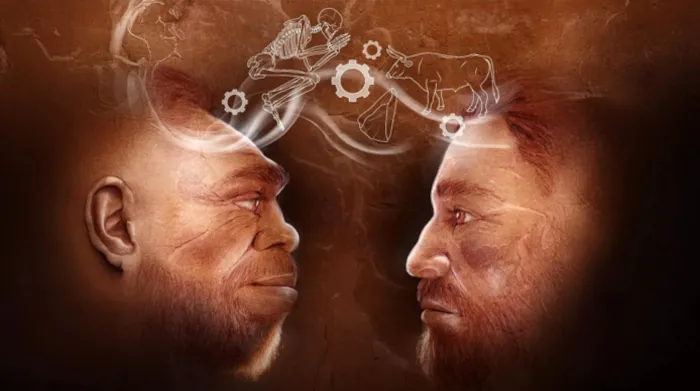
Recent archaeological findings at Tinshemet Cave in Israel and the Goyet Caves in Belgium have unveiled significant insights into the interactions between Neanderthals and Homo sapiens. Researchers, including Professor Yossi Zaidner and Israel Hershkovitz, have highlighted that these two species not only coexisted but actively engaged with one another, sharing technology and cultural practices.
Evidence from Tinshemet Cave indicates that formal burials began to appear around 110,000 years ago, suggesting that both Neanderthals and Homo sapiens developed organized rituals. The discovery of five human burials at this site points to a shared understanding of death and possibly an early belief in an afterlife. Professor Zaidner remarked, “Our data show that human connections and population interactions have been fundamental in driving cultural and technological innovations throughout history.” This statement underscores the importance of collaborative evolution in human history.
Conversely, the findings from the Goyet Caves present a darker aspect of Neanderthal behavior. Evidence suggests that Neanderthals selectively hunted and consumed outsiders, particularly vulnerable individuals from rival groups. This behavior is evidenced by bones found in the Goyet Caves, dating back to between 41,000 and 45,000 years ago. The deliberate targeting of outsiders, especially women and children, hints at organized intergroup violence, raising questions about the social dynamics of Neanderthal communities.
DNA analysis of the remains in the Goyet Caves revealed that the victims of this cannibalism did not belong to the local Neanderthal group, suggesting that these acts were not merely opportunistic but rather indicative of a complex social structure. This finding challenges previous assumptions about Neanderthal isolation and their interactions with other human groups.
Neanderthals, who are estimated to have gone extinct over 300,000 years ago, have left a lasting legacy in modern human DNA. Studies indicate that modern non-African populations possess between 2 to 5 percent Neanderthal DNA, a testament to the interbreeding that occurred between these two species. This genetic inheritance highlights the intricate web of human evolution and migration patterns, particularly in the Levant region, which is recognized as a crucial crossroads for human migration out of Africa.
Moreover, the use of the Levallois technique for crafting stone tools by Neanderthals shows their advanced cognitive abilities, paralleling those of Homo sapiens. The presence of mineral pigments, particularly red ochre, further suggests that both groups may have shared similar cultural beliefs, possibly related to death and the afterlife. Such findings paint a picture of Neanderthals as more intelligent and complex than previously thought, as noted by researcher Martina Lake, who stated, “This discovery shows that Neanderthals were more intelligent and complex than we thought.”
As these discoveries continue to unfold, they challenge long-held perceptions of Neanderthals as brutish and isolated beings. Instead, they reveal a narrative of interaction, adaptation, and shared cultural practices between Neanderthals and Homo sapiens. Chris Stringer, a prominent figure in human evolutionary studies, emphasized the interconnectedness of all human roots, stating, “When modern data from around the world was integrated to create an evolutionary tree, the mitochondrial DNA inherited from women showed that everyone’s roots were connected to Africa.” This underscores the idea that our understanding of human history is continually evolving.
Details remain unconfirmed as researchers continue to analyze the implications of these findings. The ongoing exploration of Neanderthal and Homo sapiens interactions not only enriches our understanding of ancient human behavior but also invites further inquiry into the complexities of our shared past.