Key moments
NASA has announced that the Artemis II mission, set to launch on April 1, 2026, at 6:24 p.m. EDT from Kennedy Space Center in Florida, will mark a significant milestone in space exploration. This mission will be the first crewed journey into lunar orbit since the Apollo missions over 50 years ago, a development that has generated excitement among space enthusiasts and scientists alike.
The Artemis II mission will not land on the moon but will conduct a lunar flyby, taking astronauts farther from Earth than any human has been before. The mission is expected to last approximately 10 days, during which the crew will travel about 4,700 miles away from the moon. This ambitious undertaking aims to lay the groundwork for a sustainable human presence on the lunar surface and eventually pave the way for human exploration of Mars.
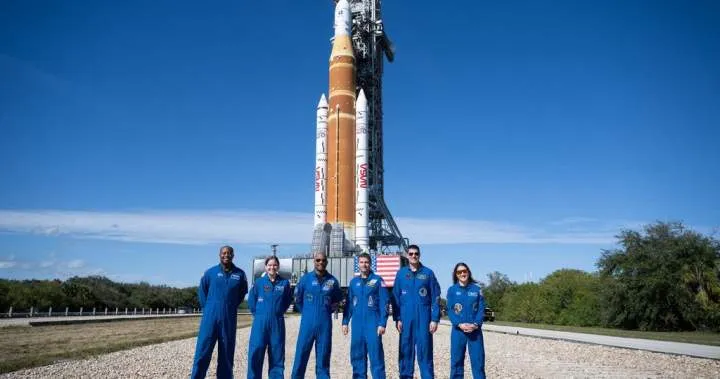
Four astronauts will be part of this historic mission: Jeremy Hansen, Reid Wiseman, Victor Glover, and Christina Koch. Notably, Hansen will be the first Canadian astronaut to participate in a lunar mission, highlighting the growing international collaboration in space exploration. This mission is not just a leap for NASA but also a significant step for the Canadian Space Agency, showcasing the contributions of Canadian astronauts to global space endeavors.
The Orion spacecraft, named Integrity, will be used for Artemis II, symbolizing the mission’s commitment to building a durable lunar presence. The Artemis program aims to explore the moon’s capabilities to support a permanent base, which could serve as a launchpad for future missions to Mars. As NASA Administrator Jeff Spaulding noted, “People are excited, and ready to go on this first chapter on our way back to the moon since the 1970s.”
In the context of space exploration history, the Apollo missions were primarily driven by the space race against the Soviet Union, with the objective of reaching the moon first. The Artemis missions, however, are focused on sustainable exploration and scientific discovery, aiming to build infrastructure and laboratories on the moon. This shift in focus reflects a broader understanding of the importance of long-term human presence in space.
As the launch date approaches, reactions from various stakeholders have been overwhelmingly positive. Elkin Norena, a prominent figure in the space community, emphasized the mission’s significance, stating, “This is a historic mission in the sense that not only are there going to be people on board going toward the moon, but they’re going to go up the farthest they’ve ever gone in over 50 years.” This sentiment resonates with many who see Artemis II as a pivotal moment in the ongoing journey of human exploration beyond Earth.
Moreover, the Artemis program has plans for future missions, including Artemis III, which will test new EVA suits for lunar surface operations, and Artemis IV and V, slated for 2028, which aim to land on the moon. These developments indicate NASA’s commitment to a sustained presence on the moon and the eventual goal of human exploration of Mars.
As excitement builds around the Artemis II mission, the implications for future generations are profound. Canadian astronaut Kutryk remarked, “If you’re a young Canadian, you should be growing up into a world where nothing is impossible.” This reflects the aspirational nature of the Artemis program and its potential to inspire future generations to pursue careers in science, technology, engineering, and mathematics (STEM).