
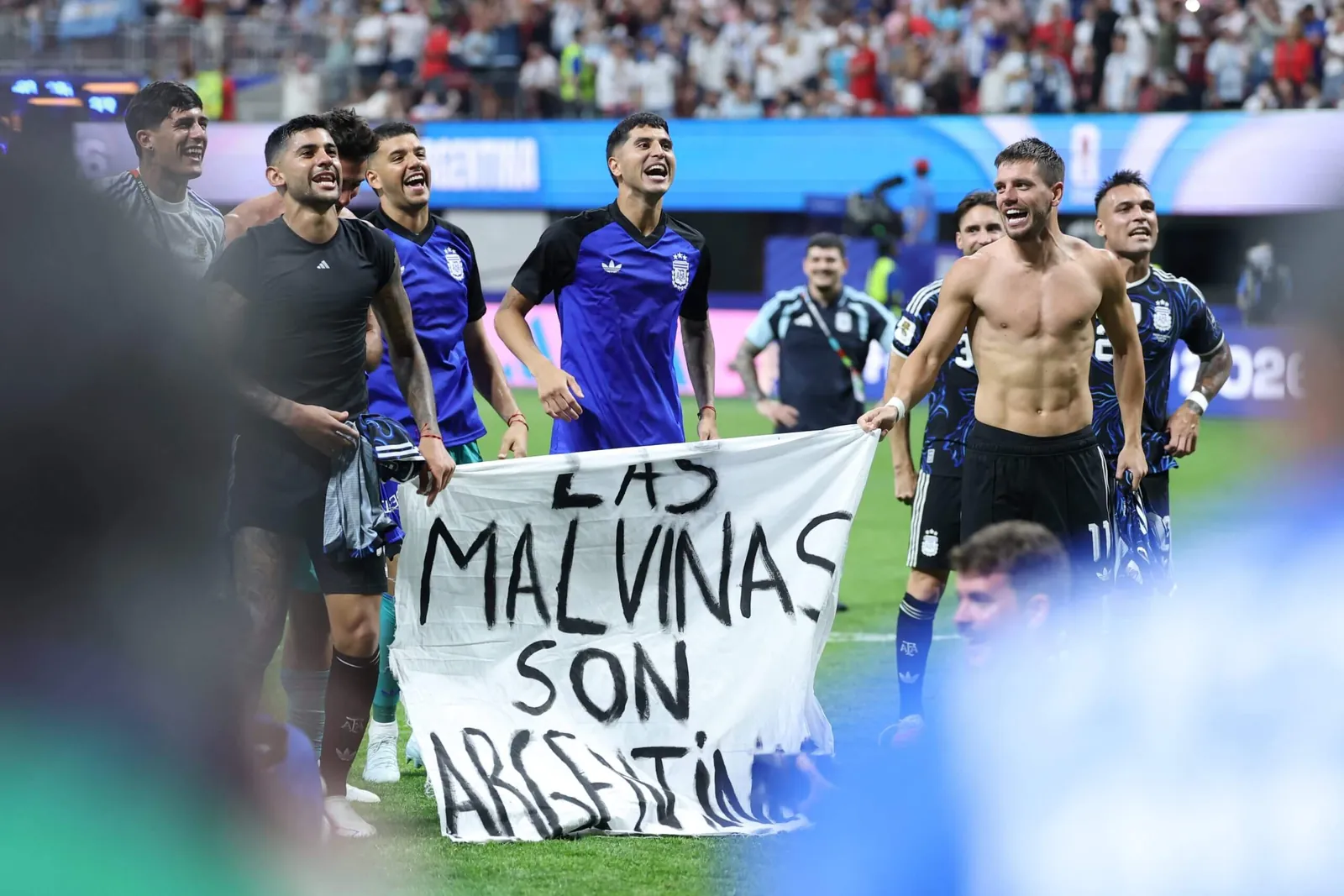
Following their World Cup semi-final win against England in Atlanta, Argentina players displayed a banner stating “Las Malvinas son Argentinas.” This message references the 1982 Falklands War, a conflict that occurred 44 years ago. The display took place after Argentina achieved a dramatic comeback, scoring twice in quick succession to secure a victory after being 1-0 down with five minutes remaining in the match. They are now set to face Spain in the final in New Jersey on Sunday.
The banner, which translates to “The Malvinas are Argentine,” was held by players Lisandro Martínez and Giovani Lo Celso. Lo Celso was also seen with Nicolas Otamendi holding the banner before it was briefly put away and then laid out on the pitch. The origin of the banner remains unclear, with reports suggesting it may have initially been displayed by supporters in the crowd. The term “Las Malvinas” is used in Argentina to refer to the Falkland Islands, a British dependency located approximately 480 km off the east coast of mainland Argentina.
FIFA Regulations and Potential Sanctions
The display of the banner could lead to sanctions from FIFA, as both FIFA and the International Football Association Board (IFAB) have strict rules against political symbols in stadiums. IFAB’s rulebook states that equipment must not feature any political, religious, or personal slogans, statements, or images. Violations can result in sanctions for the player or team by the competition organizer, national football association, or FIFA.
FIFA’s stadium code of conduct also prohibits banners, flags, flyers, apparel, and other paraphernalia that are political, offensive, or discriminatory. This includes items with wording, symbols, or attributes aimed at discrimination against a country, person, or group based on various factors such as political opinion. FIFA typically waits for match reports before making decisions, and there is no set timeframe for any potential rulings.
This is not the first instance of political banners appearing during the World Cup. Last month, during matches involving Iran in Los Angeles, Iranian Americans displayed pre-revolutionary flags, which are symbols of protest against the Tehran government. These matches, however, proceeded without incident. Argentina’s security minister, Alejandra Monteoliva, had previously stated that enhanced security measures were discussed for the semi-final, with 1,600 officers deployed and a ban on provocative messages, whether political or racial.
Historical Context and Player Reactions
The dispute over the Falkland Islands, known as Islas Malvinas in Argentina, led to a 74-day conflict 44 years ago. The conflict resulted in the deaths of over 900 people, including 649 Argentinians and 255 Britons. The historical context of the islands dates back to British claims in 1774 and reassertion of rule in 1832, followed by Argentina’s military government invading in 1982. The conflict ended with an Argentine surrender.
Following their quarter-final victory over Switzerland, some Argentina players were heard chanting, “For the Malvinas, for Diego [Maradona] and for Leo [Messi]’s last one.” Midfielder Rodrigo De Paul acknowledged the broader significance of the game, stating that while they sing about their Malvinas heroes to remember them, the match itself is a football game and political discussions should occur elsewhere. He emphasized the team’s desire to win the match to reach the final.
Argentina, the reigning world champion, will play Spain at MetLife Stadium on Sunday and could become only the third team to win back-to-back World Cups.
Read Also
Source: theguardian.com