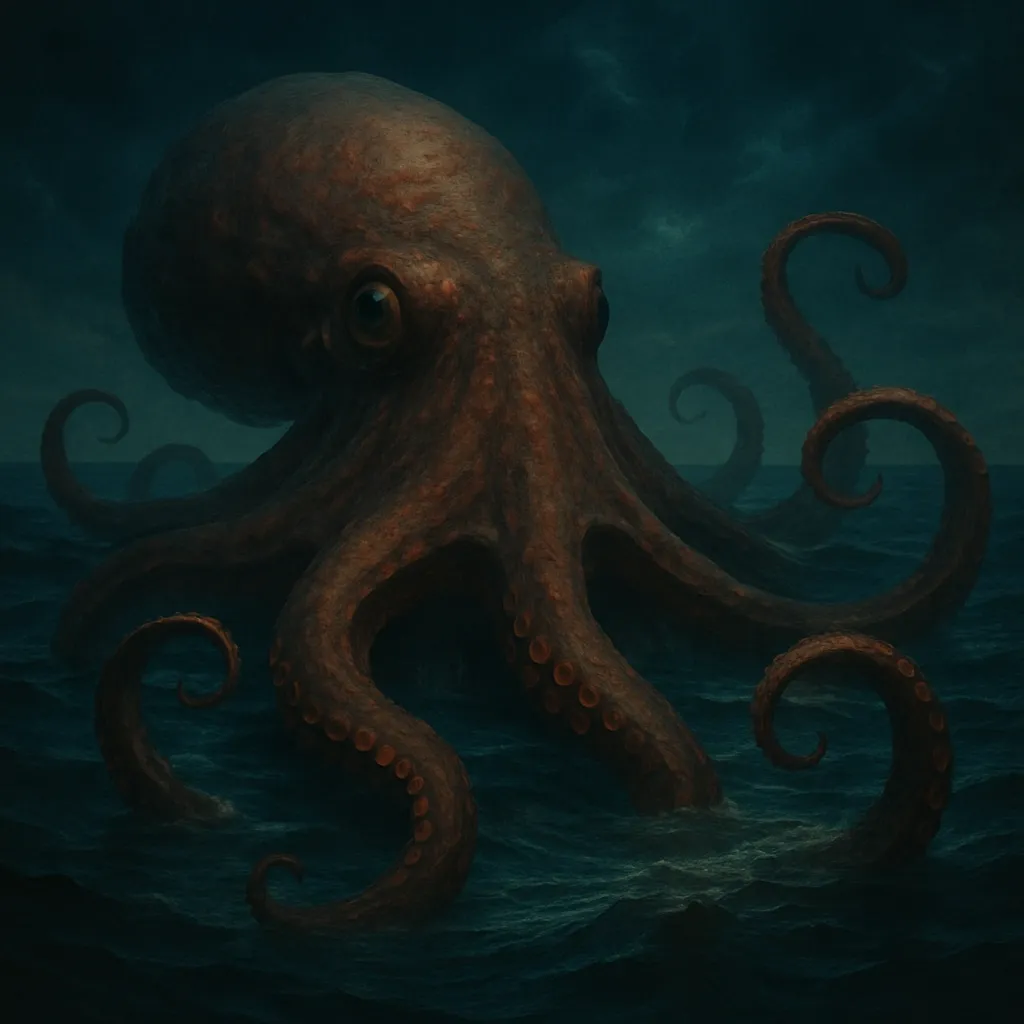
New research reveals that giant octopuses like Nanaimoteuthis haggarti may have been apex predators in the Cretaceous seas, challenging the long-held view of marine ecosystems dominated by vertebrates. These remarkable creatures lived approximately 86 to 72 million years ago, during a time when the oceans were teeming with life.
The findings emerged from a study led by Yasuhiro Iba and his team, who utilized artificial intelligence to uncover hidden fossils of Nanaimoteuthis. Their research suggests that these giant invertebrates were not merely passive participants in their environments but active hunters.
Key facts about Nanaimoteuthis:
- Nanaimoteuthis haggarti could reach lengths of up to 18.6 meters (61.02 feet).
- Nanaimoteuthis jeletzkyi, another species, ranged from 2.8 to 7.7 meters (9 to 25 feet) long.
- Fossilized beaks indicate they were apex predators, showing signs of intense wear from crushing hard prey.
- These fossils were discovered in regions including Japan and Vancouver Island, Canada.
Iba noted, “This indicates that Cretaceous marine ecosystems were more complex and included a broader spectrum of top predators than previously thought.” The presence of such large cephalopods adds a new dimension to our understanding of ancient oceanic life.
Interestingly, the jaw structure of Nanaimoteuthis, made of chitin, allowed it to process hard foods effectively. This adaptation likely facilitated its role as a formidable predator among marine reptiles and other large creatures.
Expert insights:
- Iba described these animals as a “real ‘Cretaceous Kraken'” due to their size and predatory capabilities.
- He emphasized that octopuses are not simply biting predators; they utilize long, flexible arms to capture prey.
- Jakob Vinther raised questions about the feasibility of such an animal preying on large prey items.
The implications of this research are significant. For over 370 million years, scientists believed that large vertebrates dominated marine ecosystems. Now, with evidence pointing towards giant invertebrates as apex predators, our understanding shifts dramatically.
Yet, uncertainties linger regarding the exact size estimates for Nanaimoteuthis haggarti. Some experts debate whether the maximum length could reach 60 feet—a figure some consider extreme. Regardless, these findings invite further exploration into the ecological dynamics of the Cretaceous period.