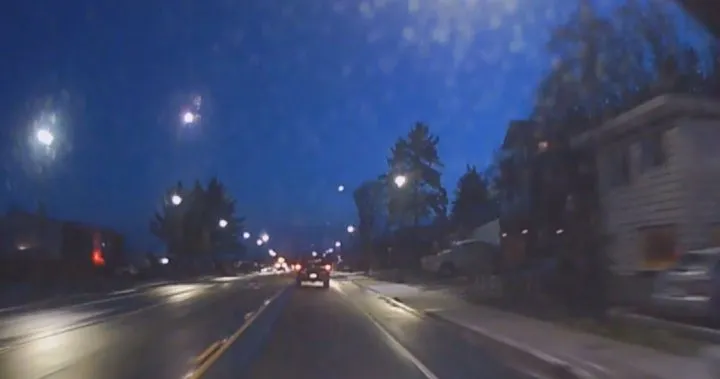
A bright fireball was observed crossing Vancouver Island at 07:12 UTC on April 29, 2026, leaving many witnesses in awe. The event unfolded as the meteor entered the atmosphere, traveling southwest before fragmenting over the Pacific Ocean, just west of Yuquot.
NASA reported that the fireball was first visible at an altitude of 90.6 km (56.3 miles) above Oktwanch Peak. It traveled approximately 89 km (55 miles) before breaking apart at an altitude of 62 km (38.6 miles). This celestial object, likely a fragment from a comet about 0.6 m (2 feet) in diameter, weighed around 454 kg (1,000 pounds).
The American Meteor Society received an impressive 135 reports and 15 videos from observers across British Columbia, Oregon, and Washington. Witnesses described a dazzling array of colors—green, blue-green, white, orange, and red.
Many reported seeing persistent trains that lingered for up to five seconds after the initial sighting. Some even noted delayed sounds resembling booms or tapping noises accompanying the spectacle.
This increase in fireball sightings can be attributed to greater accessibility to cameras and reporting tools—more people than ever are equipped to share their experiences. As Jim Todd aptly put it, “A fireball is essentially a meteor that… doesn’t zip by quickly like a shooting star but instead falls rather slowly and extremely bright.”
The event has sparked significant interest among astronomers and casual observers alike. As more individuals capture these fleeting moments on their devices, the volume of reports continues to grow.
The implications of such events extend beyond mere spectacle; they offer valuable data for scientists studying meteoric activity and its effects on Earth’s atmosphere.
As we reflect on this occurrence, it’s clear that our understanding of these phenomena is evolving alongside our ability to document them. The next steps involve analyzing the data gathered from these sightings to better comprehend their origins and trajectories.