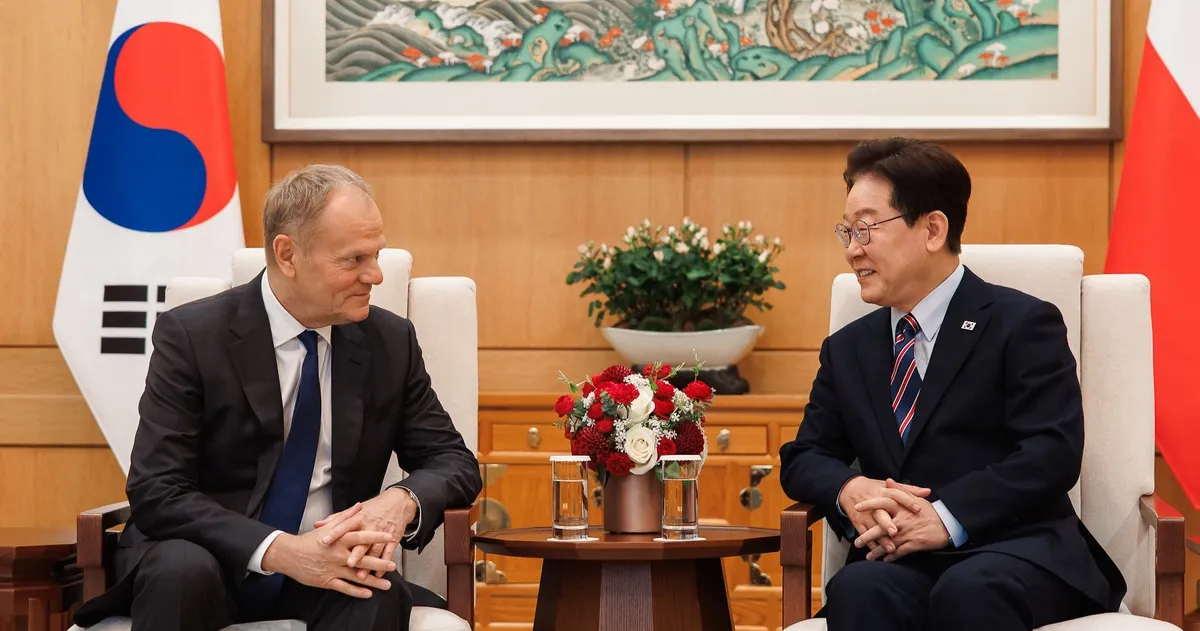
What does the recent agreement between South Korea and Poland signify for their bilateral relations and regional security? It underscores South Korea’s emerging role as a crucial ally for Poland, particularly in defense and economic investment.
On April 13, 2026, Poland and South Korea formalized an agreement to enhance cooperation across various sectors, including defense, energy, science, and infrastructure. This agreement comes at a time when Poland is increasingly reliant on South Korean military hardware, with South Korea accounting for 47% of Poland’s military imports. Notably, Poland’s Prime Minister Donald Tusk has referred to South Korea as his country’s “most important ally after the United States,” emphasizing the strategic importance of this partnership.
Tusk’s visit to South Korea marks the first by a Polish prime minister in 27 years, highlighting the deepening ties between the two nations. The backdrop of this agreement is Poland’s accelerated defense procurement following Russia’s invasion of Ukraine in 2022, which has prompted a reevaluation of its military alliances and procurement strategies. Over the last five years, Poland has emerged as NATO’s largest importer of arms, with South Korea being the primary supplier.
In addition to military cooperation, the agreement paves the way for significant economic investments. South Korea’s Hyundai Motor Group has announced plans to invest over $84 billion in South Korea over the next five years, focusing on artificial intelligence, research and development, and optimizing production facilities. This investment is expected to bolster South Korea’s industrial capabilities and further solidify its economic ties with Poland.
Moreover, Polish companies are also looking to South Korea for investment opportunities. Kumho plans to establish its first European plant in Poland with an investment of $587 million, which will produce six million tires annually. Similarly, Daesang Corporation has chosen Poland as the location for its first European kimchi production plant, indicating a growing interest in South Korea’s food industry.
As Donald Tusk noted, “South Korea is already Asia’s biggest investor in Poland,” which reflects the growing economic interdependence between the two nations. This partnership is not just limited to military and industrial sectors; it also extends to cultural exchanges, as evidenced by South Korea’s government agency for creative content opening an office in Warsaw.
However, the relationship is not without its challenges. Recently, comments made by South Korean President Lee Jae Myung regarding sensitive historical issues have drawn criticism, including condemnation from the Israeli Foreign Ministry. Lee stated, “Respect must be earned through respect,” highlighting the complexities of international diplomacy that accompany such partnerships.
As both nations move forward with their strategic partnership, the implications for regional security and economic collaboration will be closely watched. The future of this alliance remains promising, yet details regarding the full scope of their cooperation are still unfolding, leaving room for further developments in the coming months.