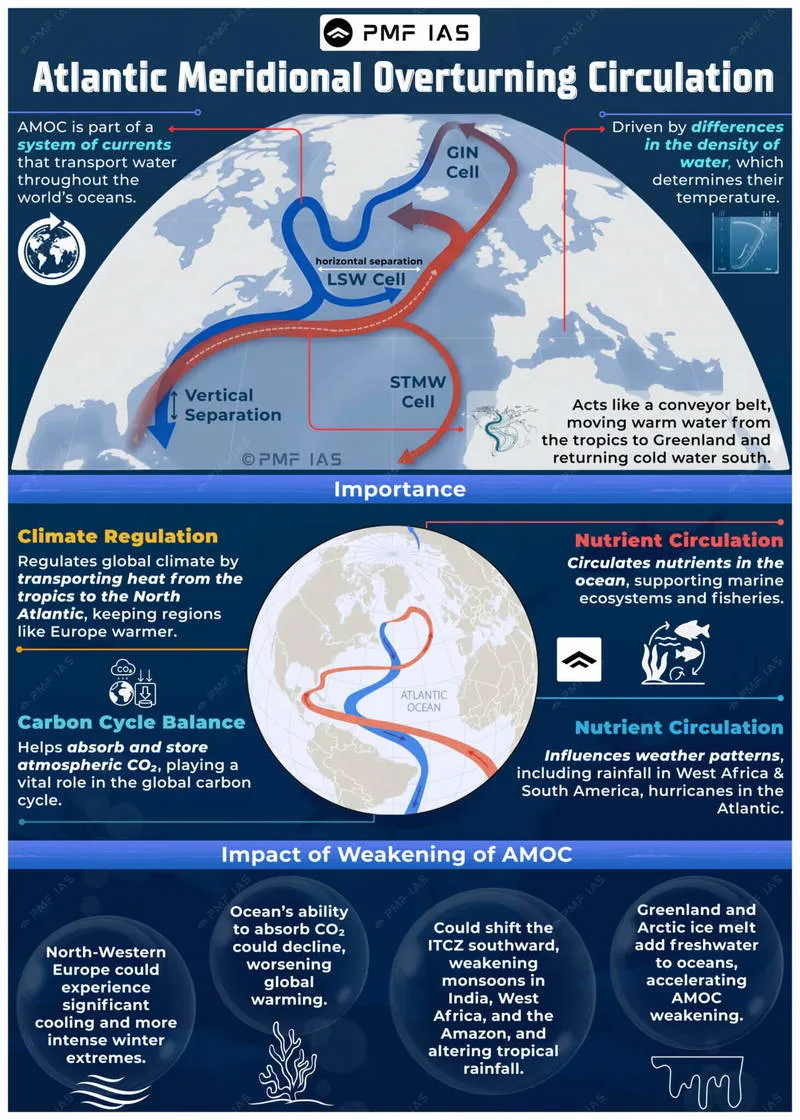
New research indicates that the Atlantic Meridional Overturning Circulation (AMOC) is at risk of collapse due to climate change, echoing scenarios depicted in popular media. This large-scale system of ocean currents has weakened by 10% over the past 20 years, raising alarms among scientists and policymakers alike.
The AMOC is crucial for maintaining a warm climate across the Northern Hemisphere. It operates like a conveyor belt, moving warm water northward while sending cold water southward. Its influence extends beyond mere temperature regulation; it affects weather patterns for hundreds of millions of people globally.
Historically, significant disruptions in ocean currents have occurred due to volcanic eruptions, which can lead to rapid cooling periods. For instance, the Younger Dryas period—occurring between 12,900 and 11,700 years ago—was previously thought to be triggered by an extraterrestrial impact. Recent research suggests volcanic activity played a key role instead.
Today, threats to the AMOC are primarily linked to human activities that increase carbon dioxide levels in the atmosphere. This excess CO₂ not only contributes to global warming but also threatens the AMOC’s ability to function as a carbon sink—an essential mechanism for absorbing atmospheric CO₂.
Climate models indicate that if greenhouse gas emissions continue unchecked, we may witness further weakening of the AMOC throughout the 21st century. Such changes could lead to decreased marine productivity in the North Atlantic, disrupting ecosystems and food sources.
In response to these challenges, scientists are exploring geoengineering solutions. One proposal involves damming the Bering Strait—an ambitious plan that could stabilize the AMOC but comes with its own set of risks and uncertainties. As Jelle Sunes notes, “Under some conditions, the AMOC remains more stable. Under other conditions, it may weaken.” This duality highlights the precarious balance we face.
The implications of a collapsing AMOC extend far beyond ocean currents; they touch on global climate stability and human adaptation. As Niklas Boers emphasizes, “The Atlantic Meridional Overturning Circulation really is one of our planet’s key circulation systems.” Understanding this system’s fate is critical for future climate resilience.